
Deixe um recado
Se você estiver interessado em nossos produtos e quiser saber mais detalhes, deixe uma mensagem aqui e responderemos assim que possível.
Chameleon Pigment for Car Paint: Why Panel Four Turns Dull
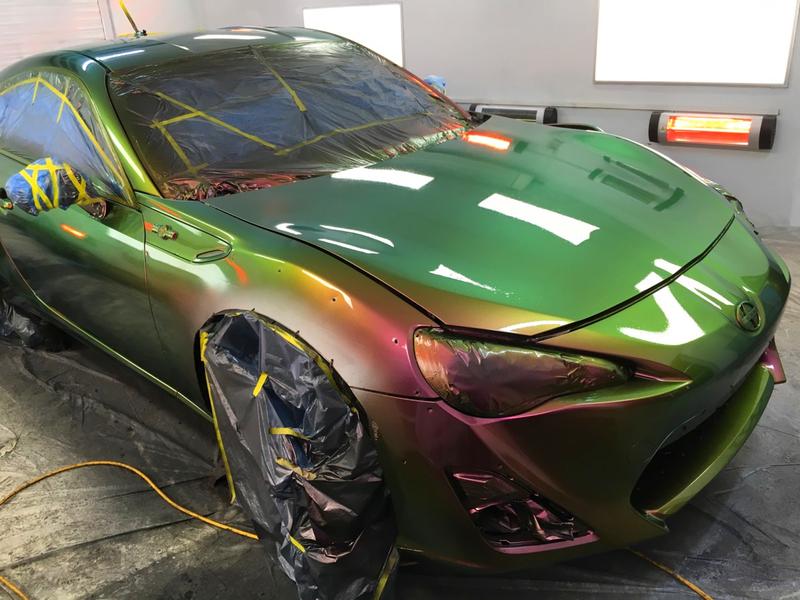
Chameleon pigment for car paint: three things drift between the first panel and the fourth. The pot, the overspray and the mirrored pass. Which one is yours?
The first panel and the fourth panel came off the same pot and they are not the same colour. Nothing was changed between them. Before you read on, stand the fourth panel beside the first in the same light and look along both of them from each end. What you are seeing is not the pigment. It is what happened to the pot, to the overspray and to the direction of the gun between the first panel and the fourth.
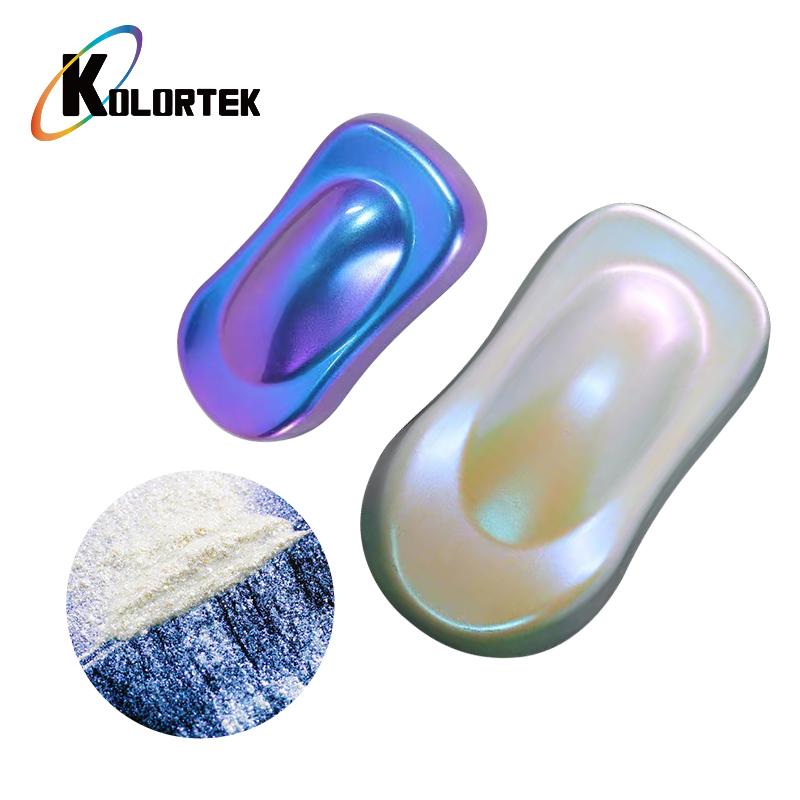
Fig. 1 — Pigment powder and two spray-out panels in the same frame. The page turns on this being a powder that gets weighed and sprayed, not a paint that arrives at a colour. Product photo.
If the problem is there, the third or fourth panel reads duller than the first, and it reads duller everywhere rather than in one place. Sometimes one edge of a panel goes grey before the rest of it — the edge nearest whatever was hanging beside it. Sometimes the two doors light up in different places as you walk between them.
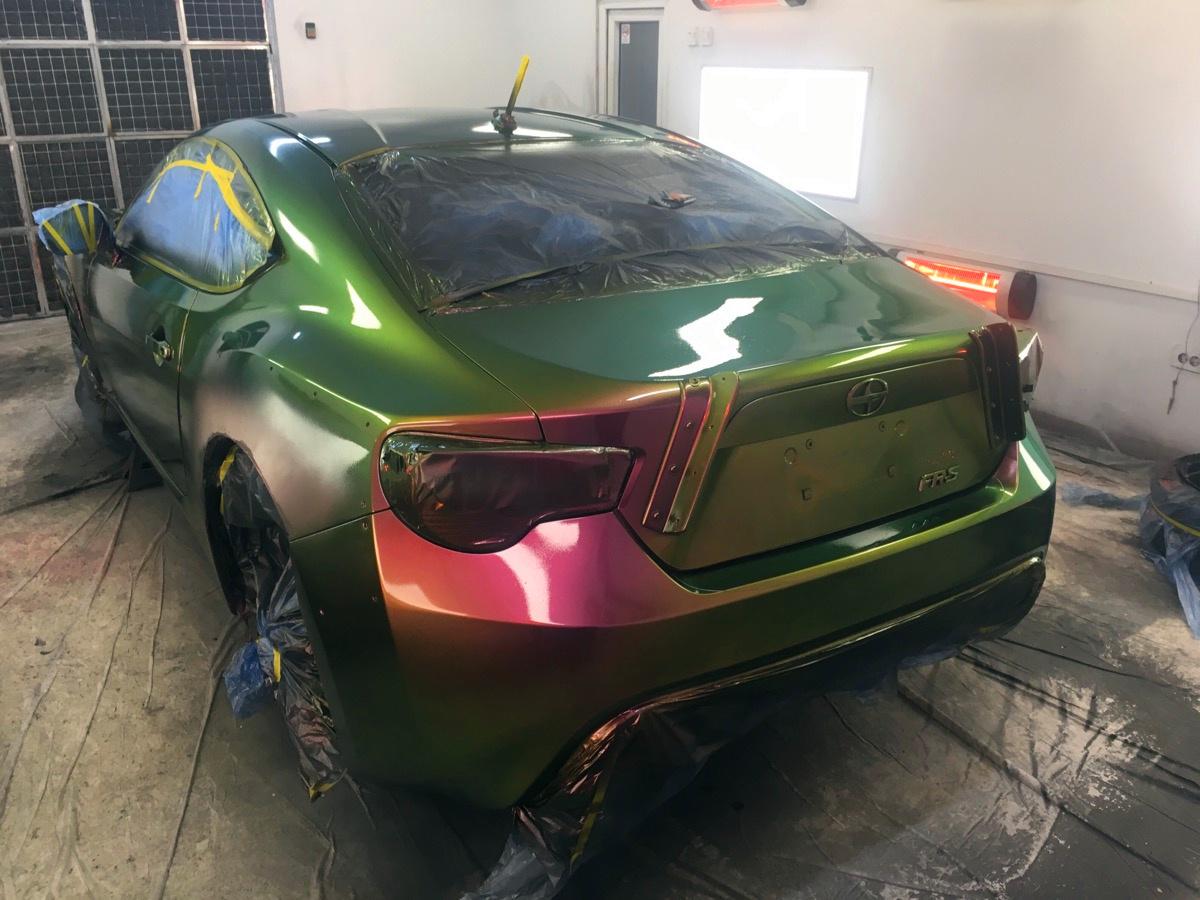
Fig. 2 — A full respray in progress inside a booth, seen from the rear quarter. Masking film is still in place, and the colour changes as the body curves away from the light. Application photo.
Three things drift across a run. The pot drifts, because an open pot loses its lightest solvent the whole time it is being worked. The overspray drifts, because while one panel is being sprayed its neighbour is already flashing off and taking dry spray along its edge. And the pass drifts, because a mirrored part can only produce a mirrored result. This page is about those three, not about particle size — that is the first thing most people reach for, and it removes none of them.
None of the three is visible on a single panel. They appear only when a run is compared against itself, which is why they survive so long in a booth with nobody doing anything wrong.
An open pot loses its lightest solvent continuously. The solvent gradient is what the levelling window is made of — the interval between a flake landing in a wet film and the viscosity rising far enough to lock that flake where it lies. Take the light fraction out and the window shortens. Less time on the panel means less time for the flakes to lie down, and weaker travel as the angle changes.
The failure does not decay smoothly. It holds, holds, and then steps down, usually around the third or fourth panel, and that step is what people remember afterwards as the paint going off. From that panel on, the flakes are getting less time than they need. So the useful question is not whether the pot is still good, but which panel is the first one that is no longer good — that tells you how much work one pot will carry.
The figures this is usually judged against are a basecoat pearlescent loading of 1–10 % by weight on a dry film of 15–25 µm. The automotive pigment grades differ in how much travel they give at the same loading.
The flake is translucent, so the effect is read against a dark ground. A pale ground washes the travel out, and no amount of window brings it back.
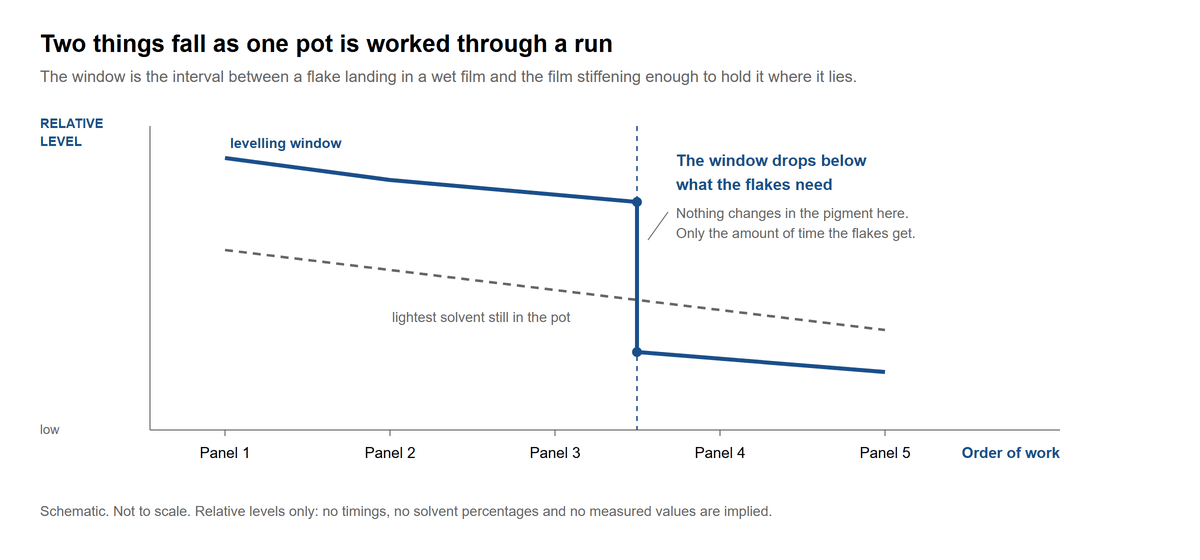
Fig. 3 — Schematic. Two things fall as one pot is worked through a run: the lightest solvent left in it, and the length of the window in which a flake can still lie down. The step between the third and fourth panel is where the window drops below what the flakes need. Not to scale. (illustrative)
While panel B is being sprayed, panel A is flashing off. A droplet that crosses the gap has spent time in the air and lost most of its solvent by the time it lands. It lands as dry spray: flakes clustered into agglomerates with very little resin around them to pull them flat.
The place to look is the edge of the finished panel nearest the panel being sprayed — a shut line, a wheel arch lip, the join between a bumper and a wing. That edge goes grey before the rest of the panel, and it goes grey in a strip rather than a spot.
The instinct is to spray that first panel harder next time, and it does not work. The defect was not made while that panel was being sprayed; it was made afterwards, by the other panel. The join has to be dealt with after the overspray, not before.
The last pass that settles alignment has names in the trade — a drop coat, an orientation coat — because alignment is set by the last wet film the flakes sit in, not by the total film. Where the clearcoat goes straight on, that last film is the chameleon layer itself: 10–15 µm wet, with a flash window left before the clearcoat.
Clearing too early traps the flakes where they lie; letting the film go too far over-orients them, which reads as mottling.
Be exact about what is mirrored. The two doors are mirror images in geometry, they face the same direction, and they take paint from the same pot through the same gun in the same session. What is also mirrored is the direction the gun travelled, and the azimuth of a flake keeps a record of the direction of the pass that laid it down.
So the tilt statistics of the two doors can be identical while the azimuth statistics are mirror images of each other. Tilt is how far a flake sits from flat; azimuth is which way it leans. The eye reads the position of the bright region, and on a mirrored azimuth that position mirrors too — standing at the front of the car and looking down both sides, you are not seeing the same distribution twice.
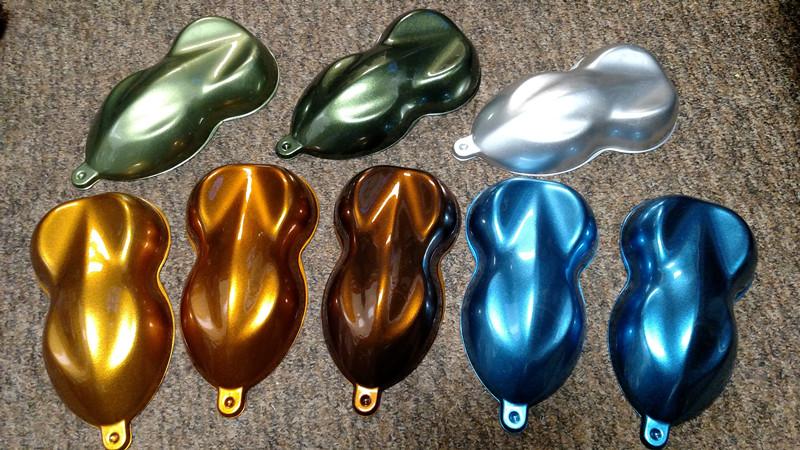
Fig. 4 — A set of curved spray-out panels laid out together, covering several colours. Read them as a group rather than one at a time — that is how the differences this page describes become visible. Application photo.
You are seeing two distributions that are mirror images of one another, which is a different thing. Both doors can be sprayed correctly and still not match; both can be sprayed identically and still not match. There are two ways out: mirror the gun direction as well, so the two distributions correspond, or accept two distributions and stop treating the difference as a fault.
This is also why a booth walks a whole side in one continuous pass instead of panel by panel. Break the side into panels and you leave a light band at every join. Continuity fixes the azimuth problem only, and it does nothing about the pot.
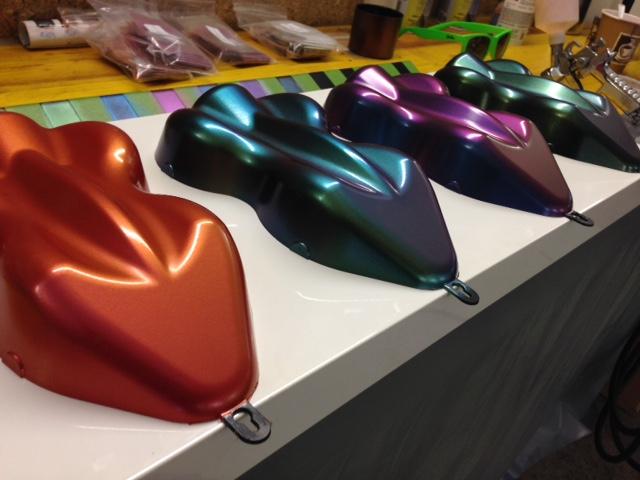
Fig. 5 — Five panels in five different colour shifts on a white stand. Changing the colour does not change the order in which the panels were sprayed. Application photo.
Two failures, two different things to look at, and both get reported as "the colour looks wrong".
Tilt. The flakes lie at an angle to the panel instead of flat against it. The panel reads flat and slightly grey, the colour stops travelling as the angle changes, and the effect weakens everywhere rather than in a pattern. People call it "this panel is lighter", which is why it gets blamed on the loading.
Azimuth. The flakes are flat but lined up along the direction of the last pass. The travel is still there, uneven in a directional way: light and dark bands appear as a viewer moves past, and the bands run with the pass rather than across it. The trade calls this tiger stripes and mottling.
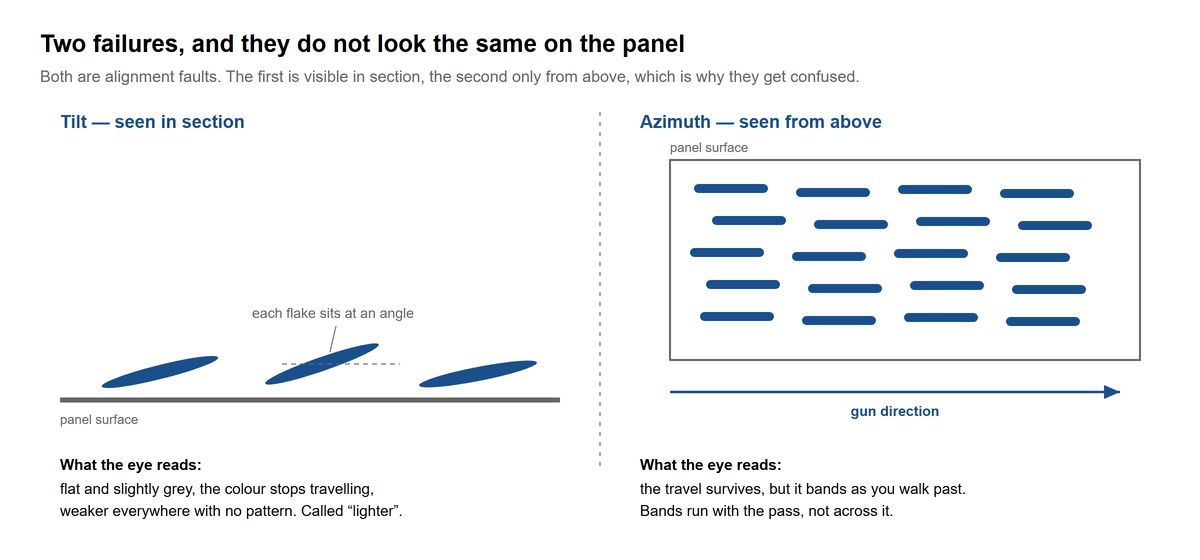
Fig. 6 — Schematic. On the left the flakes sit at an angle to the panel, so the colour stops travelling and the whole panel reads flat. On the right they lie flat but have lined up in one direction, so the panel bands as a viewer walks past it. Two different failures, two different fixes.
The fixes are not interchangeable. Tilt is a time problem — those flakes needed a longer window, so the answer is in the pot and the flash-off, not the gun. Azimuth is a direction problem — the flakes had their chance but were pushed the same way, so the answer is a final pass in another direction, or a change to how the side is walked. Adding pigment fixes neither: loading changes how many flakes there are, never which way they lie.
It is also why tilt failures cluster at the ends of the flash window. Too early a clearcoat locks misaligned platelets in place; too long a flash over-orients them.
How alignment produces angle-dependent colour at all is on the page on chameleon pigments in coatings; what makes alignment go wrong across a run of panels is here.
A spray-out panel is usually flat and usually horizontal, because that is the easy way to spray and the easy way to read. A flat horizontal panel has one orientation and one relationship to gravity, so it can produce exactly one of the outcomes the car will produce.
All three drifts are invisible on it. The pot is fresh when the panel is sprayed, there is no neighbouring panel to overspray it, and a flat panel has no mirrored counterpart.
So a panel can pass and the car can still fail, and that is not a formulation failure — it is a sampling failure. The fix is to test on a piece that faces the way the real panel faces, and to spray it at the point in the run where the real panel gets sprayed. Late, not first.
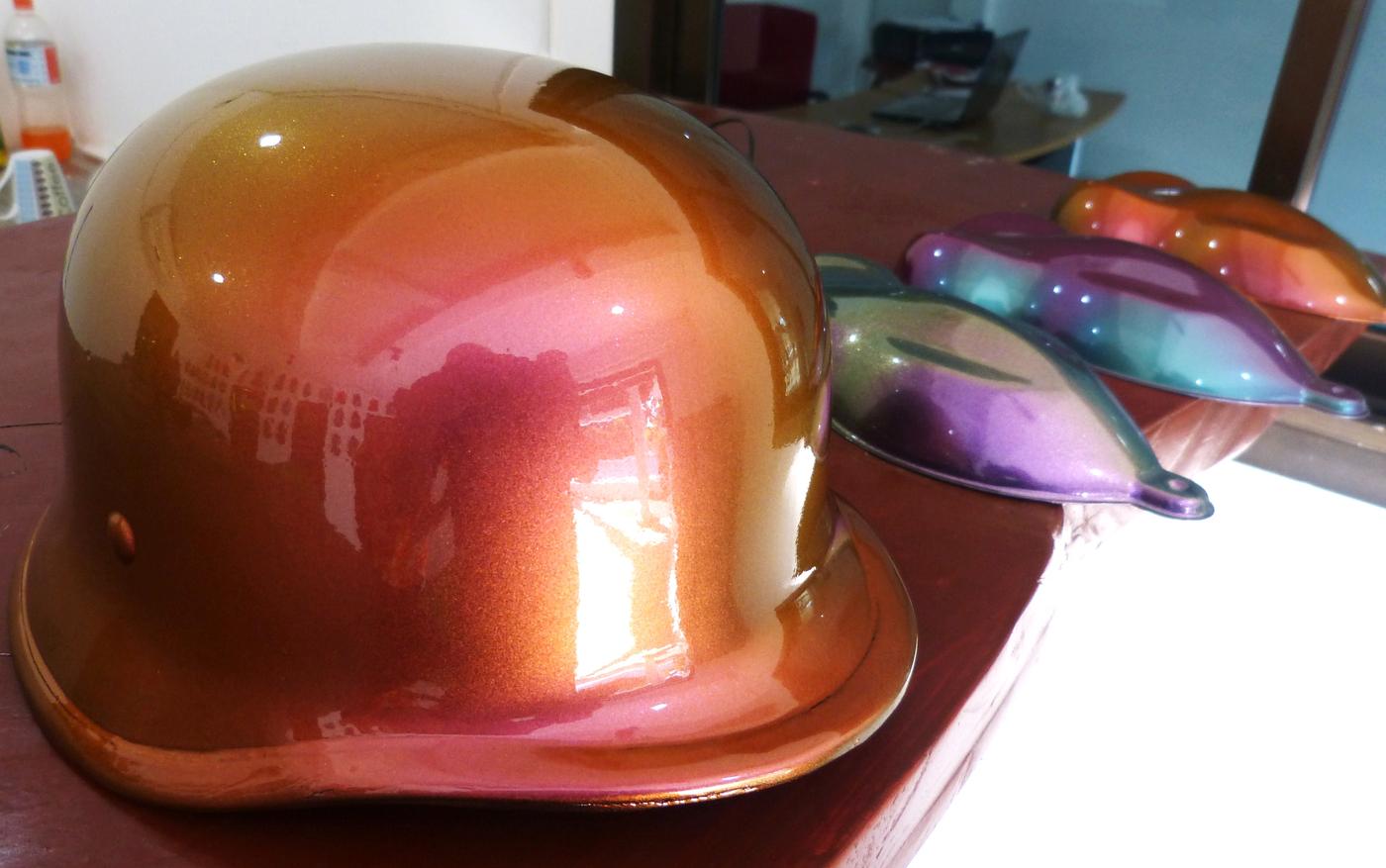
Fig. 7 — Curved spray-out pieces on a bench, with flat panels behind them. Application photo.
A finer grade makes each flake smaller, and a smaller flake removes none of the three drifts. Spraying does use finer grades than other methods, and the coarsest will block a nozzle. That is the subject of choosing a grade for automotive coatings, on another page.
The figures acceptance criteria get written against are a bake of 140–180 °C, QUV 1000 h with no significant change, and a batch-to-batch colour difference below ΔE 1.0 for OEM work.
The surface treatment a grade carries is confirmed on the specification for the grade ordered. Technical data sheet, safety data sheet and certificate of analysis are available per grade on request, and ISO 9001:2015 is held.
The three drifts are not solved by a formula. They are solved by deciding the order of work before the first pass, because all three are functions of sequence.
Which face goes first. Spray the face that is hardest to see — the one read at a glancing angle, or the one furthest from the booth light — while the pot is freshest, because that is when the window is longest. Most shops start with the most visible panel, which is backwards for this effect.
Whether the mirrored pair travels the same way. Either mirror the gun direction on the second door so the two distributions correspond, or accept two distributions and stop calling the difference a fault. Deciding this after both are sprayed is the one thing that cannot work.
Who takes the join. Where two panels meet — a shut line, a bumper to a wing — one is sprayed second and oversprays the other. Decide which one that is, and plan to deal with the join afterwards. The join is a schedule item, not a defect to be polished out.
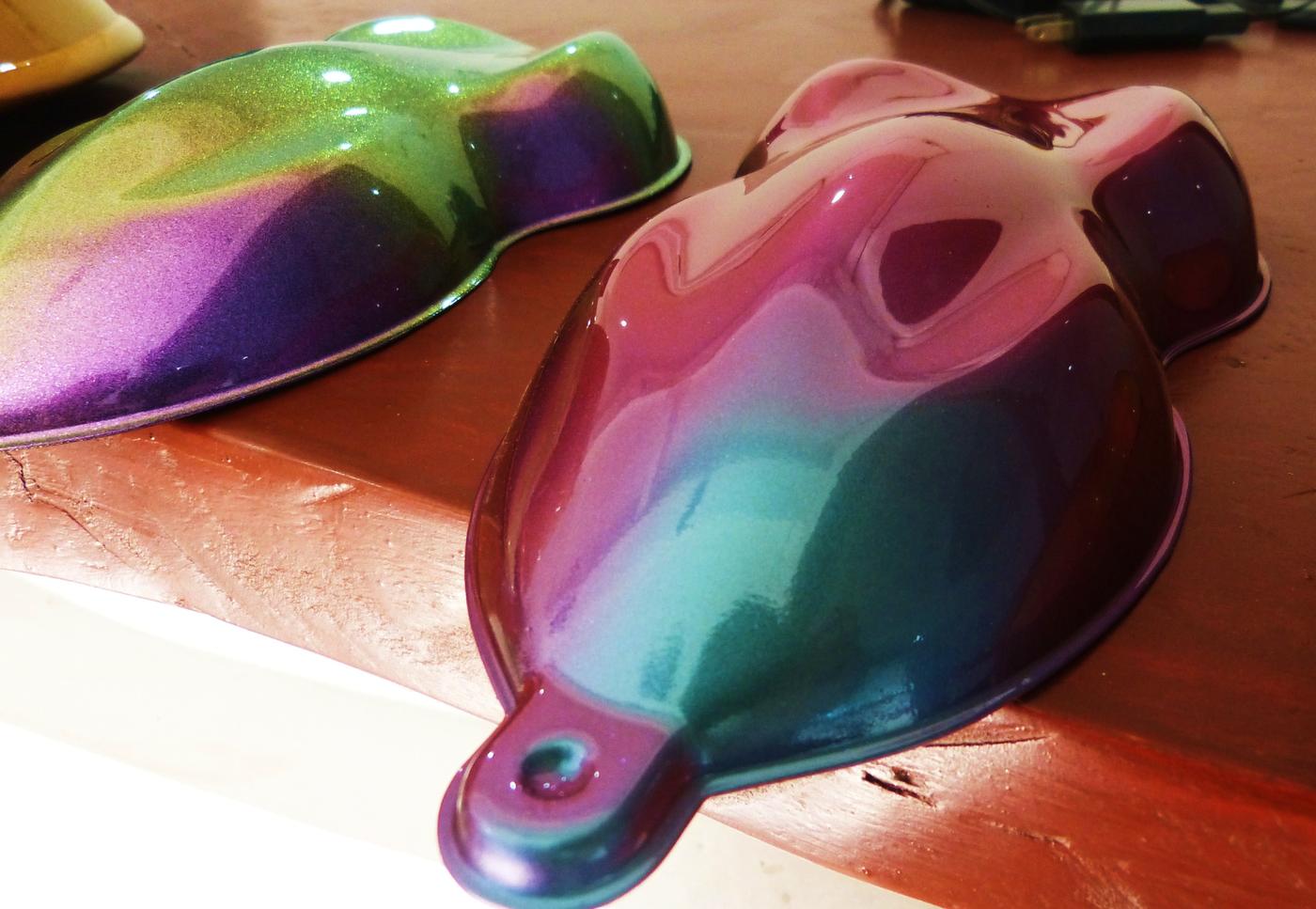
Fig. 8 — Several panels from one booth run photographed side by side. Application photo.
| What happened | What the panel shows | What to change |
|---|---|---|
| The pot drifted during the run | The later panels read duller than the first | Faster work per pot, lid on between panels, and note which panel number it turns at |
| Overspray from the panel next door | One edge goes grey before the rest of that panel | Deal with the join after the overspray, not by spraying the first panel harder |
| A mirrored pair was walked the same way | The two sides light up in different places | Mirror the gun direction, or accept two distributions and stop calling it a fault |
| The last pass ran one way only | Light and dark bands appear as you walk past | Change the direction of the final pass |
| A flat test panel passed | The defect only shows up on the car | Test on a piece that faces the way the real panel faces, late in the run |
The middle column is the only one you can fill in without instruments, which is why it is the column to check first.
Write three things on the job sheet next to the pot: the panel number the pot was opened at, the panel where the step appeared, and which way each mirrored pair was walked. Those three notes are what make the next run comparable with this one.
Often it is not the orientation of the two panels at all. Two panels facing the same way, sprayed from the same pot, can still differ, and the difference is in the sequence rather than in the angle. Before changing anything, decide which failure you have: a panel that reads flat and dull everywhere is a tilt problem, and a panel that bands as you walk past it is an azimuth problem.
No. Loading changes how many flakes are in the film; it does not change which way they lie. Adding pigment to a panel that is already failing on alignment makes it denser and less translucent and leaves the unevenness where it was. Loading is the right lever only when the problem is coverage.
The usual booth practice is to walk the length of the panel in one continuous pass, because breaking a side into separate panels leaves a light band at every join. That fixes the azimuth part. It does nothing about the pot, and nothing about the panel that is already flashing off next to the one you are spraying.
Two things are stacked on top of each other and they need separating. The mirrored pair is a mirror in gun direction as well as in shape, so the two ends can carry mirrored distributions. And the end sprayed first met a fresher pot than the end sprayed last. Check them one at a time, in that order.
Tell us three things: the panel number in the run where the difference first appears, whether the two sides were walked as mirrors or as copies, and which application method and grade the shop already uses. Tell us those three and we will tell you which of the three drifts you are looking at, and which grade suits the method you spray. The chameleon range is set out in the catalogue download.
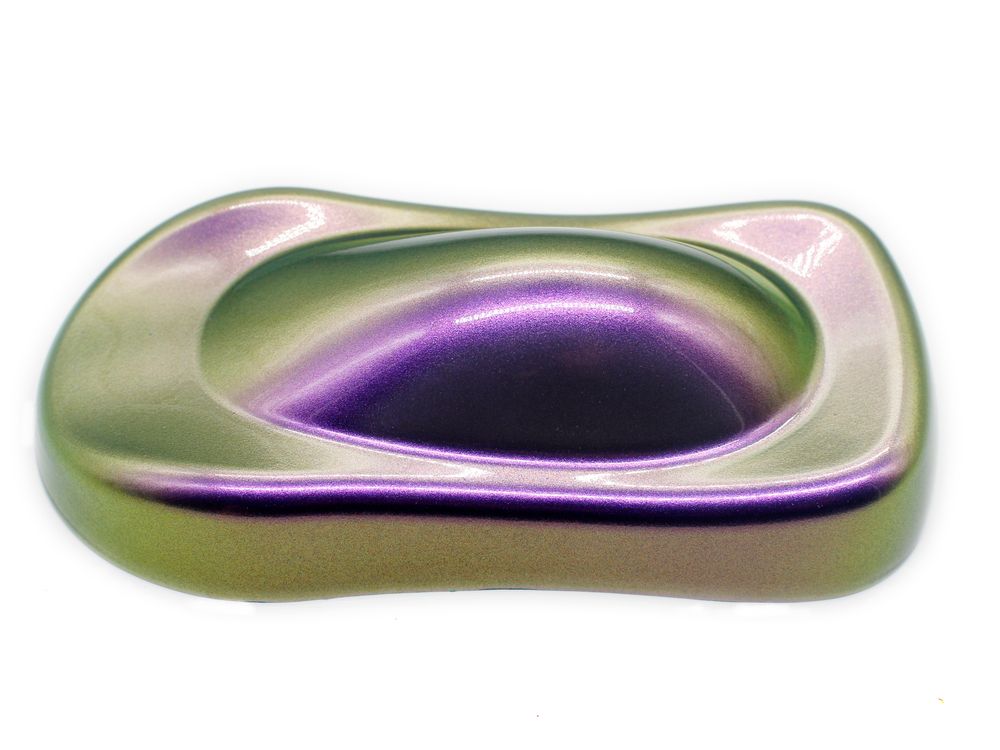
A tinta automotiva camaleão alcança seu efeito dramático de mudança de cor dependendo do ângulo, incorporando plaquetas de mica com revestimento multicamadas — como as da nossa Série KT-9000 Magic Chameleon — em um sistema de base/verniz sobre um substrato escuro. Como um produto especializadofornecedor de pigmentos com mudança de corFormulamos esses pigmentos inorgânicos para atender aos requisitos de resistência às intempéries QUV de mais de 1000 horas, proporcionando efeitos duocromáticos ou goniocromáticos multicoloridos. A seleção do tamanho das partículas — de 10 a 60 μm para partículas padrão até flocos grandes de 100 a 250 μm — determina diretamente se o acabamento terá um tom acetinado profundo ou um brilho explosivo em múltiplos ângulos.
LEIA MAIS
A série Chromashift da Kolortek é umapigmento opticamente variávelProjetado para um contraste dramático e elevado.tinta automotiva que muda de corefeitos — alternância entre duas ou mais cores vibrantes conforme o ângulo de visão muda. Construídos com tecnologia de interferência multicamadas totalmente inorgânica, esses pigmentos proporcionam a maior intensidade.tinta automotiva pigmentada para viagens de cor O desempenho em nosso portfólio combina excepcional resistência às intempéries com compatibilidade com sistemas de verniz transparente à base de solvente, à base de água e curáveis por UV.
LEIA MAIS
 Português
 English
 Français
 Deutsch
 Русский
 Español