Sixteen photochromic grades all carry the word reversible in their description, but a moulded part made from any of them can lose the effect after a few months outdoors. The term tells you the molecule returns to its starting form when ultraviolet light stops. It does not tell you how many times that return trip will complete before something else intervenes, and the intervention is the thing most datasheets leave out.
The Mechanism Is Reversible; the Count Is What Degrades
Ultraviolet energy absorbed by a photochromic molecule forces a change in its geometry. That new geometry persists while exposure continues. Remove the light and the molecule relaxes to its original shape. The word reversible describes that relaxation step. One successful cycle satisfies the definition; so does the fiftieth.
What it omits is the fraction that fails to relax cleanly. Research groups report photochromic performance as cycle counts because cycles are the measurable that falls off. Work on in-situ microencapsulated systems in textile fibres recorded grade 5 colour fastness, sub-second switching, and stable ultraviolet absorbance through 50 wash-and-exposure cycles [1]. A second encapsulated system held a contact angle near 109° after 50 washes [2].
Both numbers came from textile constructions, not from loose powder, and neither applies directly to injection moulding or solvent ink. They matter for one reason: they demonstrate which question the literature considers worth answering. A material that never recovers gets no cycle data published. When a supplier writes reversible, the question that should follow is how many times, and the answer will be test-specific rather than intrinsic to the molecule.
Single-Colour Grades Deepen; Pair Grades Transition
Photochromic powders divide into two families. Single-colour products carry one name: Purple, Blue, Yellow, Orange, Red, Green, Sky Blue, Grey, Bronze. Nine grades in total. Pair products carry two names separated by a slash: Yellow/Green, Yellow/Purple, Pink/Purple, Yellow/Red, Blue/Purple, Green/Grey, Green/Red. Seven grades. The slash marks a transition between two visible colours, not the appearance of colour where none existed.
That distinction causes more sample rejections than any other misunderstanding in the category. A buyer orders a pair product expecting a neutral base that becomes vivid under light, receives the batch, exposes it, and sees one colour shift toward a second colour they did not want. The powder is correct. The brief was wrong before the purchase order went out.
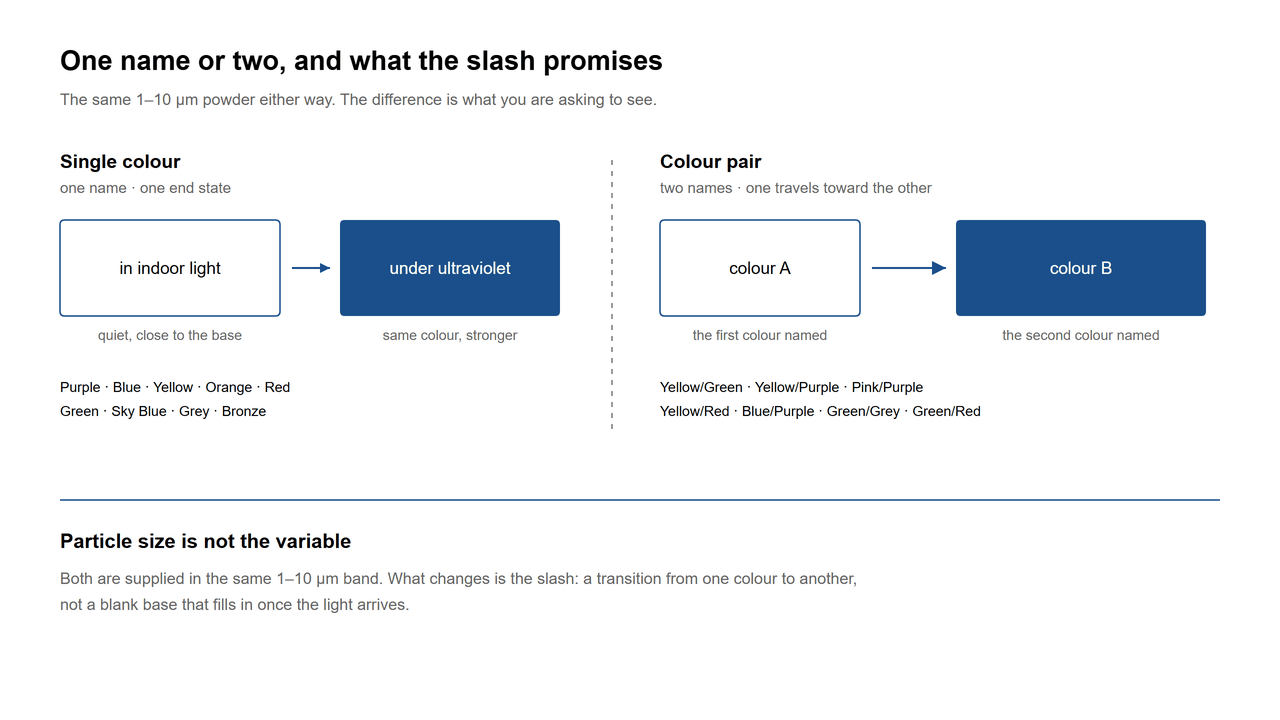
One name on the left, two on the right. A single colour deepens under ultraviolet; a pair travels from the first colour named toward the second — the slash is a transition, not a blank that fills in.
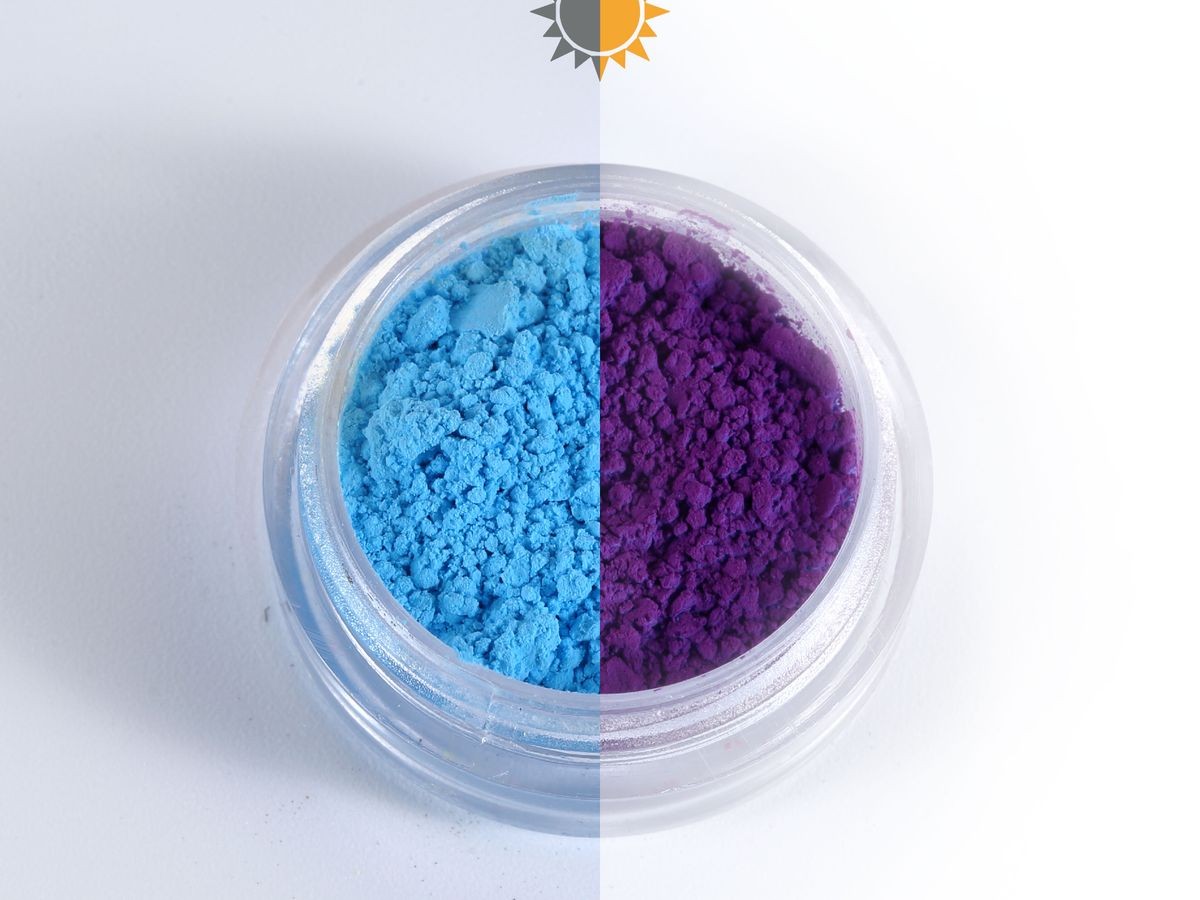
The same photochromic powder, one half kept in shade and one half under daylight. The colour change is the product; how long it survives repetition is the specification.
Pick the family first, then the shade. If the finished surface must show one colour indoors and a different colour outdoors, a pair grade is the only route. If the surface must remain unobtrusive until ultraviolet hits, a single-colour grade gives a cleaner starting point. The nine single-colour options span Bronze through to Sky Blue. Mismatched samples usually trace back to choosing by what sounds interesting rather than by what the application actually requires.
Four Mechanisms Spend the Cycle Budget
Four pathways degrade photochromic performance. They are not equally common. The order below reflects the frequency of failures reported to us, with the first accounting for most and the fourth for the fewest.
Vehicle interaction at the capsule wall
Microencapsulation isolates the photochromic system from surrounding chemistry and enables response times fast enough to be useful [3]. The capsule wall is a physical barrier, not an exclusion field. A solvent, binder component, or additive that attacks the wall removes that isolation and exposes the active material to direct contact with whatever the formulation carries. PMMA wall materials with transmittance up to 92% perform well optically [3], but whether a given wall survives your solvent requires an immersion test that no general datasheet can answer.
Decomposition temperature versus process temperature
Capsule wall polymers are characterized by maximum thermal decomposition temperatures; polyurethane shells have been reported near 426 °C [2]. That figure marks catastrophic failure of the polymer, not a safe processing window. A wall may soften, creep, or lose its seal at temperatures well below the decomposition point. A system that has been thermally compromised loses the geometry required for clean reversibility. Treat any published thermal limit as an upper boundary, never as a working target.
Accumulated ultraviolet dose
Here is where formulators who follow proper test procedures still trip. Higher dose produces faster, deeper colour development, so a brief exposure under a strong lamp looks like an improved result. It also consumes more of the reversible capacity per event. Judging a product by its appearance after ten seconds of intense ultraviolet selects for the exposure condition most likely to shorten service life, and performance rankings can reverse once realistic exposure replaces bench testing.
Mechanical degradation and washing
Wash cycles remove surface material, swell binders, and apply mechanical stress. A coating may fail one mode without failing the others. The published 50-wash contact angle of about 109° [2] and the grade 5 colour fastness [1] were measured on textile systems with their own binder chemistry and abrasion regime. Adopt the test method, not the pass criterion. If your part is wiped rather than laundered, launder data tells you almost nothing.
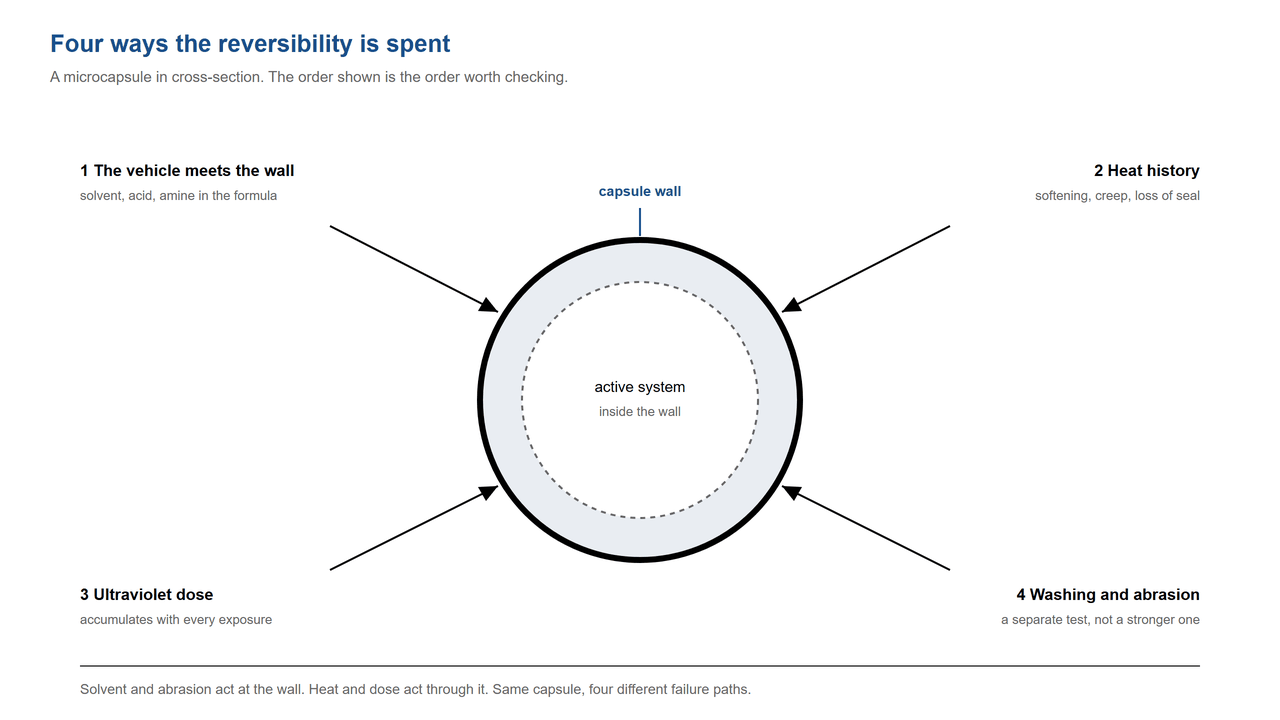
A microcapsule in cross-section with the four ways it loses performance. The wall is the shared entry point for solvent and mechanical attack; heat and dose act on it from outside the capsule.
All Grades Share One Particle-Size Band
Every powder in this range is supplied at 1–10 μm. That is not an incomplete specification; it is the specification. This band allows the material to sit in a thin printed or sprayed layer without reading as texture, which is the reason photochromic effects can be applied to packaging, labels, and coated substrates in the first place. Coarser powder would scatter light visibly before any colour change occurred.
Fine particles carry a penalty rooted in the same geometry. A given mass of 1–10 μm material presents far greater surface area than the same mass of coarse powder, and in a microencapsulated system that surface area is capsule wall. More wall per gram means more interface where vehicle interaction can occur and more barrier to maintain. It also means a weak colour response cannot be recovered by requesting coarser material, because no coarser cut is offered.
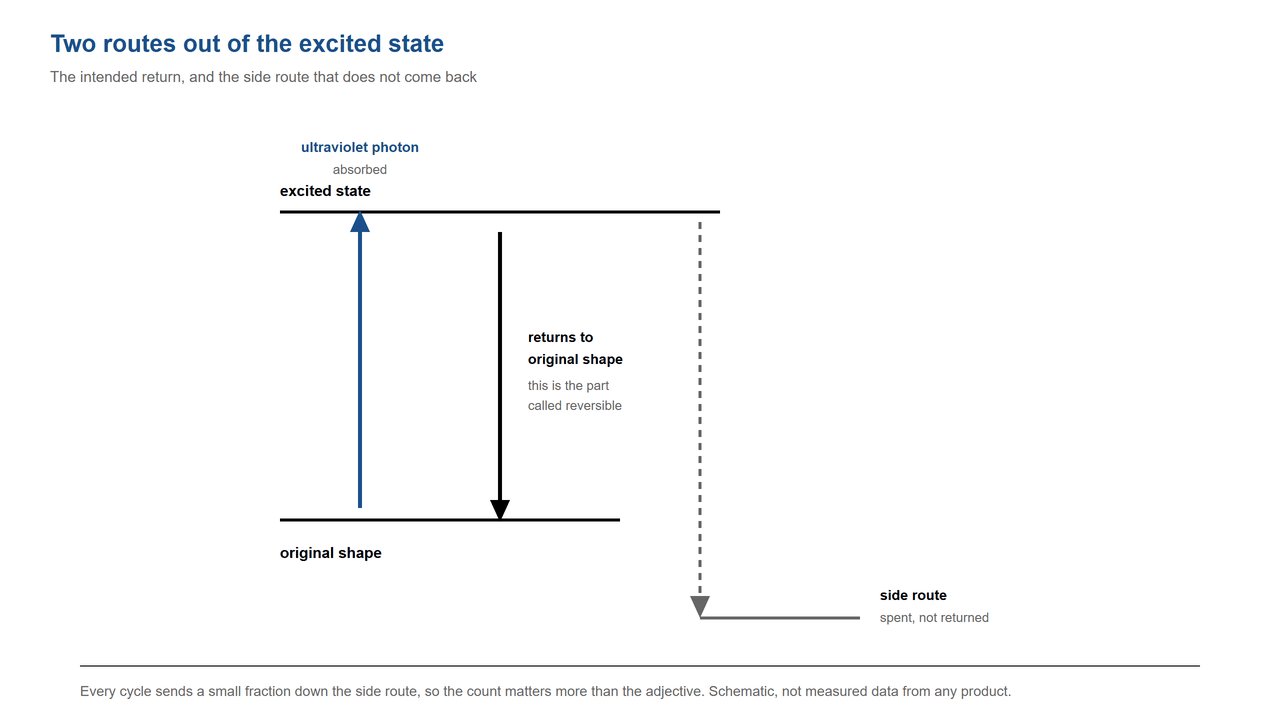
Two routes out of the excited state. The intended one returns the molecule to its original shape; the side route does not, and every cycle leaves a small fraction there. Schematic, not measured data from any product.
Questions to Settle Before You Request a Sample
Three questions resolve most specification errors. Does my brief describe a single colour that deepens, or a transition between two colours? What exposure will the part actually see in service — both total dose and duration — and does my evaluation test replicate that? What does the finished part contact besides ultraviolet light: solvent, elevated temperature, wiping, laundering, and which of those touches the capsule wall? If the second question has no answer, sample evaluation produces no useful data.
| Question |
Single-colour grade |
Pair grade |
| What the name tells you |
One colour, for example Sky Blue or Bronze |
Two colours with a slash, for example Green/Grey |
| What you should expect to see |
That one colour becomes more pronounced under ultraviolet |
One colour moving toward the second one named |
| Where it usually goes wrong |
Expecting one colour to turn into a second one |
Expecting a blank base that fills in, then rejecting a good batch |
Choose family before shade, and most disputes evaporate before a sample ships. The photochromic pigment range covers both families, and colour-pair pigments are listed separately when a transition is required. For ink and coating applications, printing applications discusses deposition methods, and the complete photochromic list appears in the photochromic catalogue.
We can identify which family matches your brief, describe how our internal tests are conducted, and state what they do and do not measure. We will not quote a cycle count lifted from another system, because that number would not transfer to yours. If you already know your exposure regime and vehicle composition, include both in the enquiry and the response will address those conditions rather than generic datasheet limits.
References
[1] Lin, L.; Ma, X.; Xue, X. et al. In-situ growth of photochromic microcapsules for the preparation of fast-response, high color-fastness smart textiles. Composites Communications 2025, 57, 102467. https://doi.org/10.1016/j.coco.2025.102467
[2] Zhang, L.; Meng, J.-G.; Liu, Y.-M.; Wang, Y.-Z.; Sun, Z.-L.; Yu, L.-J.; Gao, X.-Y.; Zhi, C. Preparation of multicolor microcapsules and their application in smart color-switching textiles. Textile Research Journal 2022, 93 (5–6). https://doi.org/10.1177/00405175221132013
[3] Wu, S.; Fan, J.; Wang, W.; Yu, D. Smart screen-printed photochromic fabrics with fast color switching performance and high fatigue resistance for energy storage applications. Colloids and Surfaces A: Physicochemical and Engineering Aspects 2022, 632, 127760. https://doi.org/10.1016/j.colsurfa.2021.127760

 Português
 English
 Français
 Deutsch
 Русский
 Español